Skip to product information
1 of 5

1G IPMX, IPMX JPEG-XS/FIP/TDC Encoder

Dedicated 1Gbps IPMX JPEG-XS encoder that turns HDMI or USB-C sources into low-latency AV-over-IP streams over standard gigabit Ethernet, powered by PoE+.

  • Encodes HDMI or USB-C sources up to 4K60 for standard 1GbE networks
  • Single PoE+ cable on Ethernet 1 for both power and video data
  • Carries USB for KVM, balanced analog audio and RS-232 control across the network
  • Built on IPMX and NMOS standards for mixing with other IPMX devices
  • Optional Dante stereo license adds networked audio without extra hardware
  • SKU:PLEX01010
  • GTIN:
  • MPN:P-AVN-4E

You need to login to view the price.

View full details

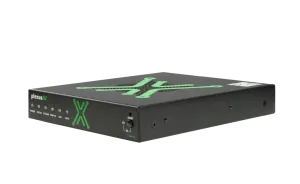
Dedicated IPMX JPEG-XS encoder for HDMI and USB-C sources

PlexusAV P-AVN-4E

The P-AVN-4E is a dedicated encoder for AV-over-IP systems that need low-latency video over standard gigabit networks. It accepts HDMI or USB-C sources, compresses them with JPEG-XS and streams them to IPMX-compatible decoders, displays and control systems. Integrators use it in classrooms, corporate meeting rooms, live production, eSports, digital signage and broadcast contribution projects. Its main benefit for the end user is that existing 1GbE infrastructure can carry high-quality video with minimal delay, without relying on a single-vendor ecosystem.

Ultra Low-Latency JPEG-XS on Standard 1GbE

Ultra Low-Latency JPEG-XS on Standard 1GbE

JPEG-XS is a light compression codec built for near-instant transport, and the P-AVN-4E uses it to move HDMI or USB-C pictures across an ordinary gigabit network at a stream bitrate of 200 to 800 Mbps. The datasheet also lists a FIP/TDC profile, which PlexusAV and its codec partner position for visually lossless quality. For the end user this means a presenter's laptop or a camera feed appears on the far display with little delay, which matters for live production, eSports and interactive meeting rooms. Because the link runs on 1GbE, many sites can reuse their existing switches instead of upgrading the backbone to 10GbE.

IPMX and NMOS Interoperability Without Lock-In

IPMX and NMOS Interoperability Without Lock-In

The P-AVN-4E is built on IPMX protocols and supports NMOS discovery and connection management through IS-04 and IS-05, with BCP-003 security. For an integrator this matters because the encoder can be specified alongside decoders, transceivers and controllers from other IPMX vendors rather than being tied to one ecosystem. The end user benefits from a system that can grow or change hardware later without replacing the whole AV chain. Note that the datasheet marks IS-11 and the HDCP key exchange profile with an asterisk as future feature options, so these should be confirmed against the firmware in use before promising them to a customer.

4K60 over standard 1GbE. Ultra low-latency JPEG-XS. One PoE+ cable.

3-year limited warranty · Open IPMX standards

Single-Cable PoE+ Installation

Single-Cable PoE+ Installation

Ethernet 1 is an RJ-45 port with PoE+ (IEEE 802.3at Type 2, Class 4), so one Cat6 or Cat6A cable can deliver both power and the video stream. Ethernet 2 is a plain RJ-45 port without PoE+ in the port listing, which gives a second network connection for separating traffic. The datasheet lists a typical operational draw of 15 W, with an eco mode of 11.4 W on firmware 1.4, well inside a Class 4 budget. For the installer this removes the separate power adapter run behind a display or in a ceiling void. For the end user it means fewer cables to damage or disconnect, which is a common cause of intermittent faults in AV rooms.

HDMI and USB-C Inputs Up to 4K60

HDMI and USB-C Inputs Up to 4K60

The encoder accepts HDMI 2.1 with HDCP 2.3 on its input and also takes USB-C with DisplayPort Alt Mode, so laptops can be connected directly. It supports 4K60 input and output resolutions, HDR10 pass-through, and EDID control set to auto, presets or manual, which helps the source negotiate a compatible signal. An HDMI loop-out lets a local monitor show the feed while it is being transmitted. In practice a teacher or executive can plug a laptop into one port and the room sees the same picture, without the source needing to know that an IP path exists. The EDID options are useful when a source behaves differently with the connected screens.

Peripheral Signals Carried Over the Same Network

Peripheral Signals Carried Over the Same Network

According to the product page, the P-AVN-4E can carry USB for KVM, balanced analog audio, AES67 and RS-232 control over the same IP network as the video. The analog audio input uses a 5-pin Phoenix connector with stereo, balanced or unbalanced channels, and the RS-232 port uses a separate 5-pin Phoenix connector. The Dante stereo license is optional and adds one stereo input and one stereo output. For the end user this reduces the number of separate cable runs between a room's sources, control system and displays. The exact KVM behaviour depends on the setup, so the integrator should test the USB path with the actual peripherals before handover.

Browser Setup, API Control and Central Management

Browser Setup, API Control and Central Management

The unit has a browser-based HTTPS web interface, a REST API and a GraphQL interface, and supports NMOS IS-04 and IS-05. The product page states that larger systems can be managed centrally with PlexusAV Visual Array. For the integrator this means configuration can be done on site from a laptop, and the encoder can be pulled into an existing building-management or control platform. For the end user, operators can change stream settings or troubleshoot remotely without visiting the rack. The front panel ID button and LED indicators for power, status, stream, HDMI-in, USB and HDCP help staff confirm the device state at a glance.

Compact Chassis With Rack and Wall Mount Options

Compact Chassis With Rack and Wall Mount Options

The chassis measures 162 x 143 x 26 mm and weighs 1.3 lbs (0.6 kg), so it fits behind a display or under a table. Official accessories include a table and wall mounting bracket, a 1RU rackmount kit that holds three units, and a 4RU kit that holds fourteen. For the installer this means one hardware family can be used both in a rack-based control room and in a discreet point-of-use installation. For the end user, the small footprint keeps the encoder out of sight in meeting rooms and classrooms while still being easy to service when needed.

Ports & interfaces15 specifications
HDMI input connector1x Type-A Female, HDMI 2.1/1.4b
HDMI input content protectionUp to HDCP 2.3
EDID controlAuto, Presets or Manual
HDMI loop out1x Type-A Female, HDMI 2.1, 1.4b
HDMI loop out content protectionUp to HDCP 2.3
USB-CSingle USB 3.0 (Video, DisplayPort Alt Mode)
Analog audio input connector5-pin Phoenix
Analog audio channelsStereo Pair, Balanced or Unbalanced
Serial control connector5-pin Phoenix
Serial protocolRS-232 "Serial"
Ethernet 1RJ-45/PoE+ (100/1000 Auto-Negotiating)
Ethernet 2RJ-45 (100/1000 Auto-Negotiating)
Cable TypeCAT6 or CAT6A shielded cable recommended
ID Push ButtonOne-click
Pinouts (analog audio and serial)Printed on chassis silk screen
Audio9 specifications
Audio signal typeLinear PCM and Pass-Through
AAC bitrate range96/112/128/160/192/224/256 Kbps
Sample Rate32/44.1/48/96/192/384 kHz
Volume adjustSlider in web-interface (+/- volume)
Dante stereo license option1x Input + 1x Output
Dante FeaturesDante Controller detects P-AVN-4E
Dante stereo PCM supportYes
Dante stereo IP input1x
Dante stereo IP output1x
Performance14 specifications
Video codecJPEG-XS
JPEG-XS profileJPEG-XS with FIP/TDC Profile
Audio codecsPCM
IPMX stream outputAuto: Follow Input
Bitrate range200-800Mbps
Encoder video scalingUpscale (up to 3840x2160)
Aspect ratio adjustmentMaintain Aspect Ratio (no change); Stretch (fill screen)
Dynamic rangeHDR10 Pass-Through; SDR (Standard Dynamic Range)
Color gamutBT.2020, BT.709, BT.601
HDMI input color formats8/10/12-bit, RGB/YUV 4:4:4, YUV 4:2:0 / 4:2:2 (<18 Gbps)
IPMX JPEG-XS stream color formats8/10-bit, RGB/YUV 4:4:4; 8/10-bit, YUV 4:2:2
HDMI output color formats8-bit, RGB/YUV 4:4:4; 8/10-bit, YUV 4:2:0; 12-bit, YUV 4:2:2
HDMI output formats3840x2160P @ 60, 50, 30, 25fps; 1920x1080P @ 60, 50, 30, 25fps; 1280x720P @ 60, 50fps
Video input formats (HDMI IN / USB-C)4096x2160P @ 60, 59.94, 50, 30, 29.97, 25fps; 3840x2160P @ 60, 59.94, 50, 30, 29.97, 25fps; 1920x1080P @ 60, 59.94, 50, 30, 29.97, 25fps; 1280x720P @ 60, 59.94, 50, 30, 29.97, 25fps; 720X576P @ 60, 59.94, 50, 30, 29.97, 25fps; 2560x1600P @ 60fps; 2560X1440P @ 60fps; 2560X1080P @ 60fps; 2160x1440P @ 60fps; 1920x1200P @ 60fps; 1680X1050P @ 60fps; 1600x1200P @ 60fps; 1440x900P @ 60fps; 1280x1024P @ 60fps; 1024x768P @ 60fps; 800x600P @ 60fps; 640x480P @ 60fps
Network5 specifications
Web interfaceBrowser-based HTTPS Web-UI and Control
HTTPS APIREST API, GraphQL
NMOS supportIS-04, IS-05, IS-11*, BCP-003
IPMX technical standardsTR-10-1, TR-10-3, TR-10-5*, TR-10-8, TR-10-9, TR-10-11, TR-10-12
Controlled and managed byPlexusAV Visual Array
Power6 specifications
Power input12V/3A DC, center-positive
PoEPoE+: IEEE 802.3at Type 2 Class 4 compliant
External power supply12 V DC/3A (optional, sold separately)
Power consumption (operational mode)15 W Typical
Power consumption (eco mode, FW 1.4)11.4 W
PolarityCenter-Positive
Weight & dimensions2 specifications
Size162 mm x 143 mm x 26 mm (6.37” x 5.63” x 1.02”)
Weight1.3 lbs (0.6 kg)
Operational conditions4 specifications
Operating temperature-13° to 113° F (-25° to 45° C)
Storage temperature-40° to 113° F (-40° to 45° C)
Operating humidityLess than 95% (non-condensing)
Acoustic noise33 dBA (normal operation)
Other features9 specifications
LED indicators(1) Power, (2) Status, (3) Stream, (4) HDMI-IN, (5) USB, (6) HDCP
Factory resetPress and hold recessed button for 10 seconds
Warranty3-year limited warranty
1RU rackmount kitP-AVN-M-1RU: 3x P-AVN-4E 1RU Rackmount Kit Frame
4RU rackmount kitP-AVN-M-4RU-KIT: 14x P-AVN-4E 4RU Rackmount Kit Frame
Table and wall mounting bracketP-AVN-M-WAL (set of 2)
Power supply accessoriesP-AVN-PSU-TYPE-A-US; P-AVN-PSU-TYPE-C-EU; P-AVN-PSU-TYPE-G-UK; P-AVN-PSU-TYPE-I-AUS
ID LightWhen ID mode is on, LED is lit and HDMI output shows system information
Future feature option (*)Indicates a future feature option

Specifications are checked against the manufacturer's documentation where available.