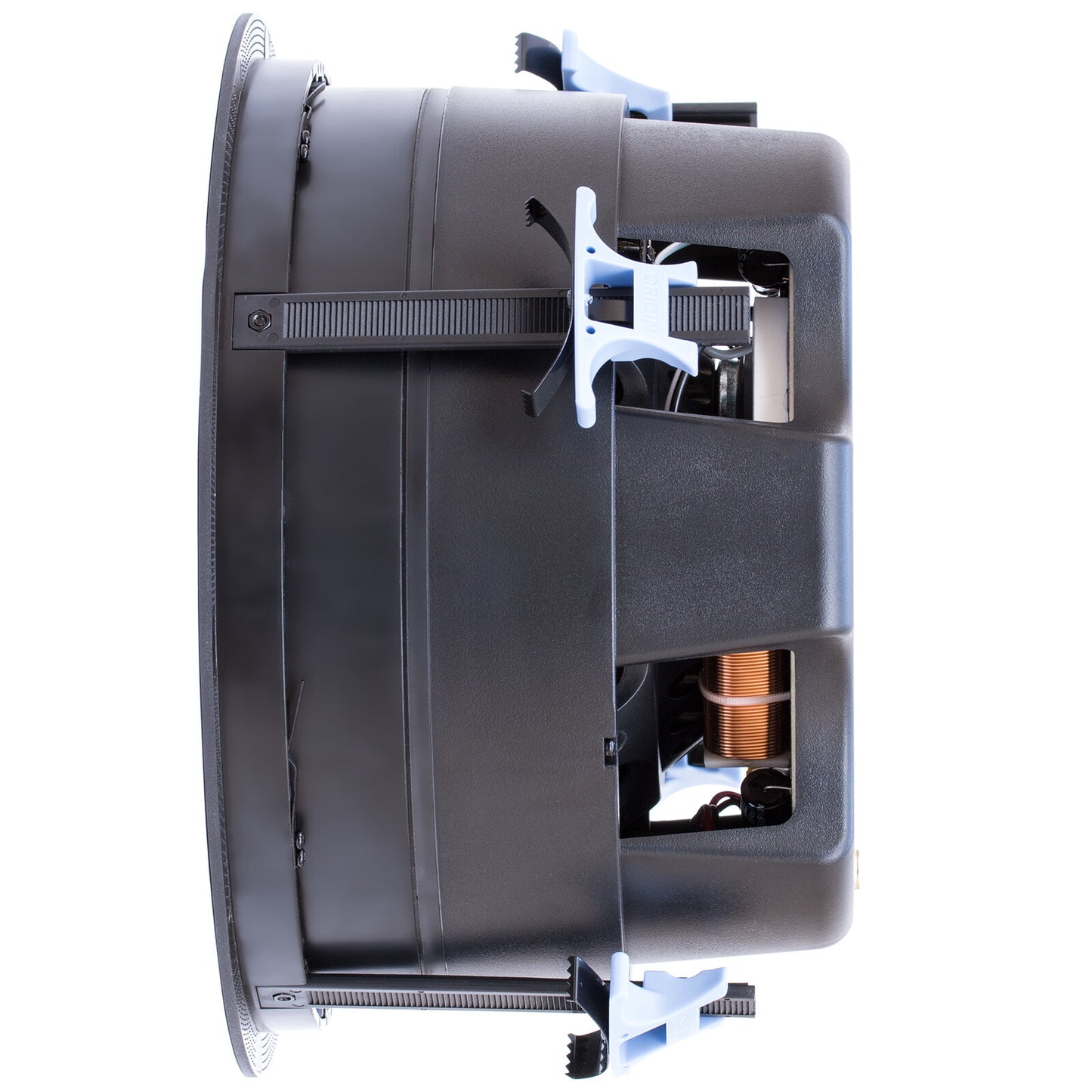
Flagship 3-way in-ceiling architectural loudspeaker
Origin Acoustics D109
The Origin Acoustics Director D109 is the flagship of the Director 100 Series — a fully pivoting, three-way in-ceiling loudspeaker engineered for premium residential installations, dedicated home theaters, and high-end whole-home audio projects. Purpose-built for integrators who refuse to compromise on fidelity, it combines a 10-inch Kevlar woofer, a 4-inch Kevlar midrange, and a patented Silk DPSD tweeter in Origin's TriLinear Configuration, delivering genuinely deep bass, articulate mids, and refined highs from a flush-mount position. What makes it especially compelling for professional installations is that this full-size 10-inch driver fits into a cutout equivalent to a conventional 8-inch speaker — meaning more bass capability with less ceiling disruption. A tool-less spring-clip mounting system and magnetic micro-bezel paintable grille round out a design that is as easy to install as it is invisible once finished.

TriLinear 3-Way Pivoting Configuration
The D109 uses Origin Acoustics' TriLinear Configuration (TLC) — a stacked arrangement of three drivers where both the 4-inch Kevlar midrange and the Silk DPSD tweeter pivot independently of the woofer. This means the high-frequency energy can be aimed directly at the primary listening position regardless of where in the ceiling the speaker is installed. In a real room, this is significant: off-axis installs — above a sofa offset to one side, for instance — no longer mean compromised tonality. The listener receives the full, on-axis frequency response rather than a rolled-off approximation. For integrators, it dramatically reduces placement constraints during design, and for the end user it means the speaker sounds like it is in front of them, not above them.
Patented DPSD Tweeter Technology
The Dual Plane Stabilized Diaphragm (DPSD) tweeter is an Origin Acoustics patent. Unlike a conventional dome tweeter — where the suspension attaches only at the voice-coil — the DPSD design anchors the suspension at both the voice-coil and the peak of the dome. This dual attachment prevents the diaphragm from rocking off-axis under high excursion, which lets the crossover point be set considerably lower than typical. The practical result is a much wider, smoother handoff between midrange and tweeter: improved dispersion across the listening area, reduced intermodulation distortion at high volumes, and greater dynamic headroom before audible strain. End users get a high-frequency performance that is noticeably cleaner and more effortless at realistic listening levels.
10-inch bass. 8-inch cutout. Zero visible compromise.
IPX6-rated · Authorized integrator channel only · Origin Acoustics Director Collection
10-Inch Bass in an 8-Inch Footprint
The D109 requires only a 10.375-inch (264mm) ceiling cutout — the same diameter as a conventional 8-inch in-ceiling speaker — while housing a full 10-inch Kevlar woofer. Origin Acoustics achieves this by engineering the basket geometry and mounting flange to minimise the overall diameter without reducing the effective cone area. For integrators, this opens up retrofits in homes where the existing rough-in holes are sized for 8-inch speakers, and it avoids structural complications in newer builds with tighter joist spacing. For the end user, it translates directly into a 25Hz lower frequency limit and the kind of room-filling bass that would normally require a standalone subwoofer or much larger speaker.
X-Wave Woofer Surround
When a conventional woofer cone reaches its mechanical limit and stops abruptly, energy reflects back across the cone surface as standing waves, audible as a particular harshness or muddiness at high SPL. Origin Acoustics' X-Wave surround uses a progressively stiffer compliance geometry that absorbs this energy rather than reflecting it. The result is a measurable reduction in cone-break-up distortion, particularly in the 80–300Hz range where midrange clarity is most at risk during bass-heavy content. For a ceiling speaker that cannot be repositioned away from the listener, this kind of controlled low-distortion behaviour at high excursion directly translates into a more natural, fatigue-free listening experience over long sessions.
Tool-Less Spring-Clip Mounting System
The D109's mounting system uses spring-loaded clips with multiple points of ceiling contact, requiring no separate installation tools for final fitment. Unlike traditional dog-leg clamps that concentrate clamping force at two points and can damage thinner drywall, the multi-contact clips distribute load more evenly across the ceiling surface. This reduces the risk of ceiling cracking over time and dampens vibration transfer between the speaker basket and the structure — a genuine acoustic benefit, not just a convenience claim. In practice, installers report faster, repeatable installations with fewer callbacks, and end users benefit from a speaker that stays seated and vibration-free through years of operation.

IPX6 Water-Resistance Rating
The entire Director Collection, including the D109, carries an IPX6 rating. IPX6 certifies protection against powerful water jets from any direction — well beyond what a bathroom steam environment or humidity from an outdoor-adjacent ceiling would present. This makes the D109 a legitimate specification choice for pool houses, covered outdoor rooms, bathrooms, steam-adjacent areas, and marine-adjacent installations where a standard residential speaker would fail prematurely through corrosion or driver degradation. For integrators, being able to specify a single speaker model across both dry and moist-area zones simplifies procurement and inventory.
On-Board Bass and Treble EQ Switches
Unlike the entry-level models in the Director 10-inch series, the D109 (and D107) include both bass and treble EQ adjustment switches on the crossover board. These allow on-site voicing without additional external components: the bass switch compensates for in-wall boundary reinforcement when the speaker is installed close to a wall or corner, and the treble switch corrects for ceiling material absorption or unusual room acoustics. The ability to fine-tune the response at the speaker itself saves time during commissioning, eliminates the need for an EQ band on the amplifier, and gives integrators a straightforward tool for achieving flat, accurate playback in rooms where acoustics are less than ideal.